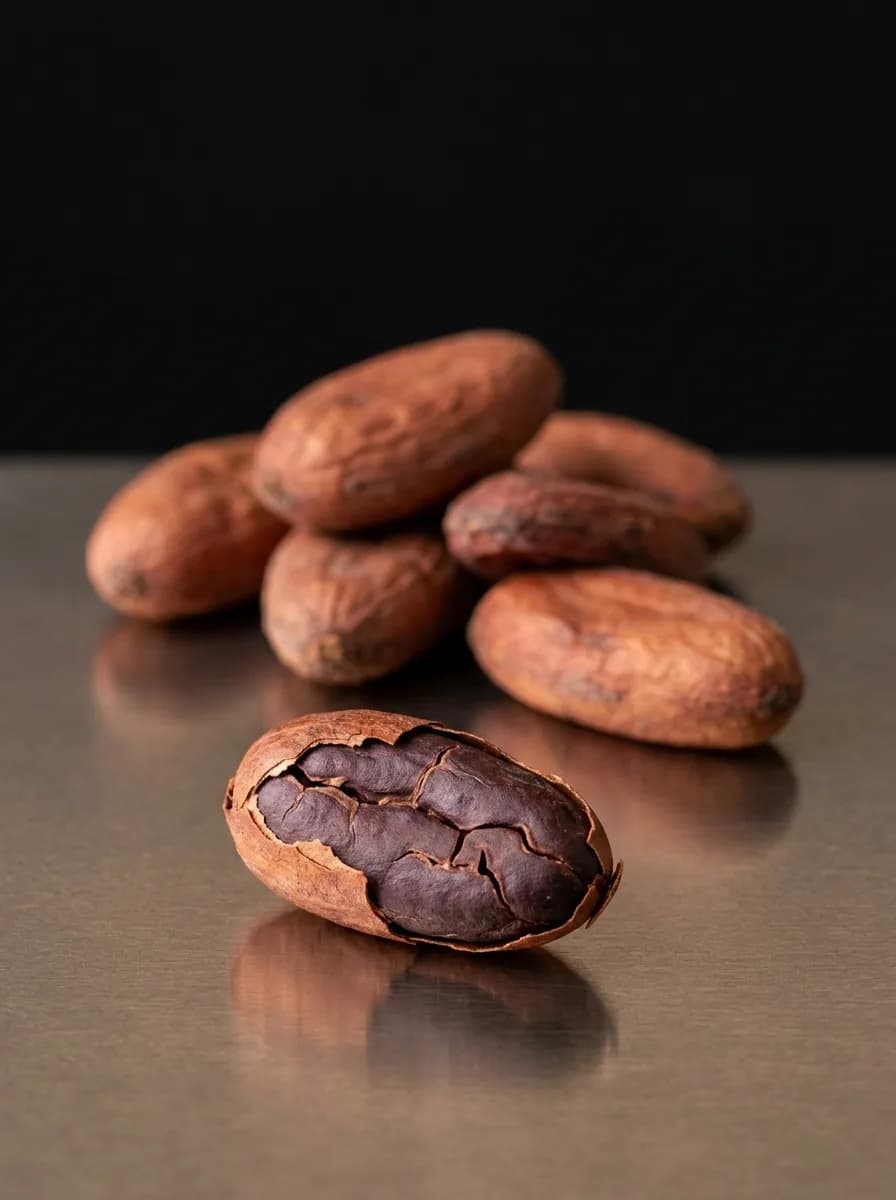
Wholesale Cocoa Beans | Bulk Cocoa Beans Ecuador
Buy wholesale cocoa beans from Ecuador. Premium Nacional Arriba variety from Manabí, fermented and sun-dried in our own plant. Fully traceable B2B supply for international chocolate makers and craft bean-to-bar chocolatiers.
Technical Sheet
- Nacional Arriba variety, Fine Aroma
- Technical sheet and cadmium analysis available upon request (EU Reg. 488/2014)
- Formats: 1-5kg sample · 60kg bag · pallet · container
Technical Sheet
| Parameter | Technical Specification |
|---|---|
| Variety | Nacional Arriba Variety (Fine Aroma Cacao) |
| Fermentation | 5 to 6 days in laurel wood boxes, with daily temperature and humidity tracking. |
| Moisture | Maximum 7.0%, ensuring physical stability during long-term storage and ocean freight. |
| Physical Format | Whole dry beans, sorted by size and free from agricultural debris. |
| Sensory Profile | Pronounced floral aroma (jasmine and orange blossom), citrus fruit notes, low bitterness and astringency. |
| Shelf Life | 24 months when stored in a cool, dry place away from strong external odors. |
| Packaging | 60 kg net food-grade jute bags with optional hermetic GrainPro inner liners. |
How Buyers Use Ecuadorian Cocoa Beans
A bean is not a commodity once you look at what it has to do downstream. Roasters, grinders and craft makers each stress a different parameter — bean count, moisture, fermentation index, shell ratio — and the same lot can be excellent for one and wrong for another. This is how our Nacional Arriba and CCN-51 lots are actually used.
Bean-to-bar and craft chocolate
Makers buying fine aroma are buying the fermentation, not just the genetics. A well-fermented Nacional Arriba lot carries floral and jasmine notes that survive a light roast; an under-fermented one will not, no matter how prestigious the variety on the paperwork.
Industrial grinding and cocoa processing
Grinders care about consistent bean size and moisture at or below the contract maximum, because both drive winnowing yield and shell contamination. CCN-51 lots are the volume-oriented option here, since the variety fills a container without the scarcity constraint of Nacional.
Blending programmes
Many industrial buyers combine a fine-aroma base with a higher-yield variety to hit a target flavour at a workable cost. We say plainly which part of the blend is Nacional and which is CCN-51 — a blend presented as 100% Nacional is a claim we will not sign.
Roasting and speciality retail
Roasters selling origin-labelled beans need the traceability to hold up: province, farm network, harvest window and post-harvest protocol. Our post-harvest is centralized in our own facility, which is what makes those records consistent rather than reconstructed.
Cosmetics and derived extraction
Where the bean is an input for extraction rather than for flavour, the parameters that matter are the analytical ones — heavy metals, pesticide residues, microbiology — and we supply the panel the destination market demands.
What We Supply — and What We Do Not
Capacity figures in this industry are read as minimums far too often. Ours are ceilings on what we can produce, never a floor on what you have to buy. Here is the honest boundary.
- Nacional Arriba fine-aroma beans and CCN-51, sorted and with post-harvest processed at our own facility.
- Commercial MOQ of 250 kg; volume then scales up to pallet, LCL and full container.
- Standardized fermentation in wooden boxes and controlled drying, documented per lot.
- Heavy-metal, pesticide and microbiological analyses on request, priced and timed per panel.
- Traceability to province and farm network, with Agrocalidad fumigation and certificate of origin for export.
- FOB Guayaquil for containers and FOB Quito (Tababela) for air lots.
- —No container-scale supply of 100% Nacional Arriba. Fine aroma is genuinely scarce; at large volume the honest answer is a documented Nacional plus CCN-51 blend, stated as such.
- —No organic certification of our own. Where an organic lot exists, the certificate belongs to the operator that holds it.
- —No cadmium-free claim — cadmium is present in all cacao and what applies is the limit of your market, evidenced lot by lot.
- —No GrainPro liners or jute sacks included in the price: export packaging is quoted separately and goes on the buyer's account.
- —No inland or international freight arranged by us.
- —No fixed quotation from memory. Cocoa trades against the exchange and every quotation is revalidated.
Origin & Traceability
Our cocoa beans are sourced from a network of around 100 allied farms across the provinces of Manabí, Esmeraldas and Pichincha, some of Ecuador's most traditional cacao-growing regions. We partner directly with these vertically integrated farms, ensuring direct control over agricultural practices. Post-harvest processing is centralized at our own facility in Cayambe, Pichincha, executing standardized fermentation and solar drying. Each shipment is fully traceable, linking the final bag to its specific lot and cultivator.
Origin Resources
Read more about our process and the origin of our fine aroma cocoa.
Formats & MOQ
We provide flexible supply chains for global cocoa importers and confectionery brands. Our standard minimum order quantity (MOQ) is 250 kg for commercial testing. For large industrial contracts, we consolidate loads onto pallets, Less than Container Load (LCL), or Full Container Load (FCL) shipped from the Port of Guayaquil.
B2B Purchasing Process
Step 1
RFQ & Specs: Submit a Request for Quote (RFQ) indicating your volume requirements and target destination port.
Step 2
Sample Despatch: We ship 1 to 5 kg samples via international courier for sensory and physical validation in your lab.
Step 3
Contract Agreement: We align on technical specifications, dispatch schedules, and commercial payment terms.
Step 4
Shipping & Delivery: We handle customs clearance at the Guayaquil port and provide full shipping documentation (BL, CoA).
Food Safety
In accordance with European Commission Regulation (EU) No 488/2014, heavy metals in cocoa-derived products are subject to strict maximum limits within the EU market (e.g., 0.10 mg/kg for milk chocolate, 0.30 mg/kg for milk chocolate with >30% cacao, 0.80 mg/kg for dark chocolate with >=50% dry cocoa solids, and 0.60 mg/kg for cocoa powder). While raw cocoa beans as a raw material are not directly restricted by a specific threshold in the regulation (being intermediate goods), their final application is strictly governed. We offer Inductively Coupled Plasma Mass Spectrometry (ICP-MS) cadmium testing per batch on request, backed by the plant's ongoing Good Manufacturing Practices (GMP) certification.
B2B Frequently Asked Questions
What is the difference between ASSS and ASE cocoa beans?↓
What Incoterms do you offer for bulk shipments?↓
Are your cocoa beans certified organic?↓
What is the transit time to main European ports?↓
How do you protect cocoa beans from humidity during sea transit?↓
Can you ship a full container of 100% Nacional Arriba every month?↓
Are your beans certified organic?↓
What moisture level do you ship at, and why does it matter?↓
How long does a first order take?↓
Ready to Start Your B2B Sourcing?
Request wholesale FOB/CIF pricing, order sample boxes (1-5kg), or discuss customized specification sheets.
The True Cocoa Origin: Single Origin Ecuadorian Nacional Cacao B2B Sourcing
Access our knowledge library featuring commercial sourcing guides and deep B2B import specifications.