Cadmium Distribution by Cacao Product: EU Regulation 488/2014 Compliance
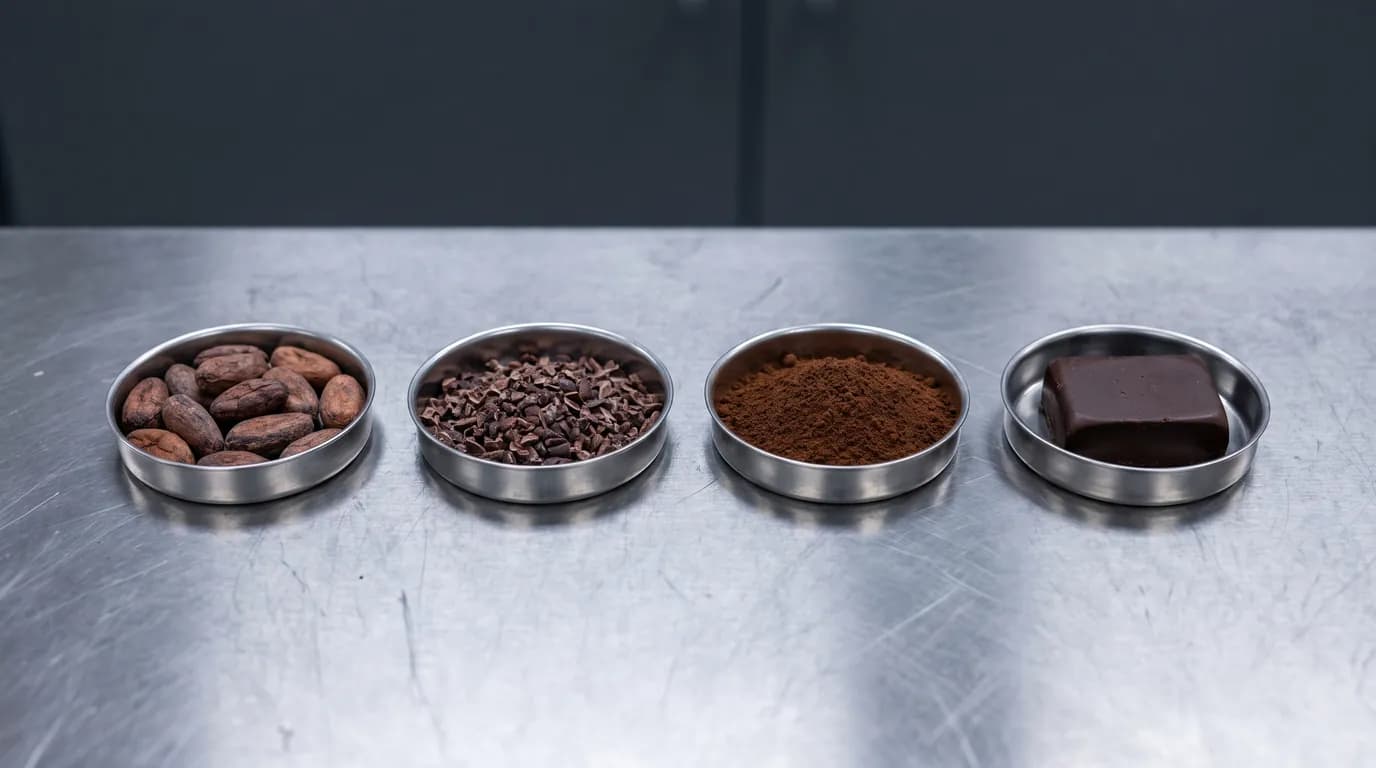
Table of Contents
- 01How Cadmium Distributes Inside the Cacao Bean
- 02The Four EU Thresholds by Product Format
- 03Why Cocoa Powder Is the Highest-Risk Derivative
- 04Cocoa Butter: The Lowest-Risk Derivative
- 05Cocoa Liquor: The Middle Reference Point
- 06Cadmium by Derivative: A Compliance Reference Table
- 07Farm Selection and Laboratory Verification
- 08Specifying Compliant Derivatives for Your Production
For European chocolate manufacturers, importers, and B2B distributors of cacao derivatives, understanding how cadmium distributes across each product format is the key to building a compliant supply chain. Under EU Regulation 488/2014, the same raw cacao bean can yield a derivative that sails through customs or one that is rejected outright, depending entirely on which fraction of the bean is extracted. This technical guide explains why cocoa powder concentrates cadmium while cocoa butter carries almost none, how that shapes your risk by product, and how El Dulce Origen manages compliance across its derivative range.
How Cadmium Distributes Inside the Cacao Bean
Cadmium is a naturally occurring heavy metal in the volcanic soils of Ecuador's coast and Andean region. Cacao trees absorb it through the root system, mistaking it for essential nutrients such as zinc and calcium, and transport it via the xylem into the cotyledons of the bean. Crucially, once inside the seed, cadmium does not distribute evenly: it binds to the non-fat solids, specifically the proteins and fiber of the cotyledon, and has virtually no affinity for the lipid (fat) fraction.
This single biochemical fact drives the entire compliance math for cacao derivatives. Because cadmium partitions into the solids, any process that removes fat concentrates the metal, and any process that isolates fat leaves the metal behind. For a B2B buyer, this means the same harvest can produce a cocoa butter that is essentially cadmium-free and a cocoa powder that exceeds the EU limit, from the very same beans. Understanding this distribution is the foundation of specifying the right raw material for each application.
The Four EU Thresholds by Product Format
EU Regulation 488/2014 sets maximum cadmium levels based on the dry cocoa solids content of the finished product. These four thresholds, expressed in mg/kg (ppm), are the numbers every European buyer must build into their specification sheets:
- Milk chocolate with < 30% dry cocoa solids: 0.10 mg/kg
- Milk chocolate with 30% to < 50% dry cocoa solids: 0.30 mg/kg
- Dark chocolate with > 50% dry cocoa solids: 0.80 mg/kg
- Cocoa powder sold to the final consumer: 0.60 mg/kg
For the full regulatory framework and how it applies to importers, see our guide on EU cadmium limits and compliance. The practical consequence is that the binding constraint depends on your end product: a dark chocolate maker faces the 0.80 mg/kg ceiling, while a cocoa powder brand faces the far tighter 0.60 mg/kg ceiling on a material that is inherently more concentrated.
Why Cocoa Powder Is the Highest-Risk Derivative
Cocoa powder is produced by pressing cocoa liquor to remove the cocoa butter, leaving behind the defatted solids. Because cadmium resides in those solids, pressing does not remove the metal; it concentrates it. Industry research and our own experience show that cocoa powder typically carries two to two-and-a-half times the cadmium concentration of the raw bean it came from.
This means a lot of beans reading 0.35 mg/kg, which would comfortably pass as whole beans or as liquor, will produce a powder at roughly 0.70 to 0.85 mg/kg, exceeding the 0.60 mg/kg retail limit. To export compliant cocoa powder, the raw beans must start from a very low baseline, typically below 0.25 mg/kg, sourced from farms with neutral-to-alkaline soils that naturally limit cadmium uptake. This is why upstream farm selection is not a nicety but a hard requirement for any powder program.
Cocoa Butter: The Lowest-Risk Derivative
At the opposite end of the spectrum sits cocoa butter. Because cadmium binds to proteins and fiber rather than lipids, hydraulic pressing that extracts the pure fat fraction leaves the cadmium behind in the pressed cake. Properly pressed cocoa butter therefore contains virtually no cadmium, typically below the detection limit of 0.01 mg/kg. For manufacturers of white chocolate, confectionery coatings, or cosmetic cocoa butter, this makes the fat fraction structurally the safest derivative from a heavy-metal perspective.
It is worth noting that at El Dulce Origen, cocoa butter and cocoa powder are produced together under a tolling arrangement, sold as a combined 30 percent butter and 70 percent powder split, available from one container upward. This reflects the industrial reality that the two fractions are co-products of the same pressing operation, and it lets buyers plan their derivative mix with full visibility of where the cadmium risk lands, in the powder, not the butter.
Cocoa Liquor: The Middle Reference Point
Cocoa liquor, also called cocoa mass or paste, is the ground whole bean with nothing added or removed, so it contains both the fat (roughly 52 to 54 percent) and the non-fat solids (46 to 48 percent). Its cadmium level is therefore directly proportional to the baseline concentration of the raw bean, making it the natural reference point between the low-risk butter and the high-risk powder.
For compliance planning, liquor is where buyers should anchor their testing. A liquor reading gives you the bean baseline, from which you can predict the powder concentration by applying the two-to-two-and-a-half-times factor, and confirm the butter will be negligible. Our F1 and F2 fine-flavor grades, primarily Nacional Arriba and fine-flavor balao and amelonado varieties, are offered across beans, liquor, nibs, butter, and powder, with the same soil-level mitigation applied upstream regardless of the final format.
Cadmium by Derivative: A Compliance Reference Table
The table below summarizes how cadmium behaves in each derivative and which EU threshold typically governs it. Use it as a quick reference when specifying raw materials for different end products:
| Derivative | Cadmium behavior | Typical EU ceiling | Risk level |
|---|---|---|---|
| Cacao beans (whole) | Sets the baseline | Indirect | Medium |
| Cacao nibs | Equal to cotyledon solids | 0.60 mg/kg (powder ref.) | Medium |
| Cocoa liquor / paste | Proportional to bean | 0.80 mg/kg (dark choc.) | Medium |
| Cocoa powder | Concentrated 2 to 2.5x | 0.60 mg/kg | High |
| Cocoa butter | Below detection | Low | Very low |
The clear takeaway: if your application uses cocoa powder sold to consumers, your upstream bean selection must target the lowest cadmium baselines in your portfolio. If your application is cocoa butter or high-percentage dark chocolate, your risk envelope is considerably wider. For the agronomic techniques that keep those baselines low, see our guide on mitigating cadmium in cacao soils.
Farm Selection and Laboratory Verification
The foundation of compliant derivatives is compliant soil. El Dulce Origen works directly with approximately 100 allied farms across Manabí, Esmeraldas, and Pichincha, at altitudes from 0 to 800 meters, selecting parcels with neutral-to-alkaline soils, typically pH 6.2 to 7.2, that naturally lock cadmium into the soil matrix. Our processing facility is located in Cayambe, Pichincha, but our agronomic footprint spans all three provinces, and that direct relationship is what allows us to allocate the lowest-baseline lots to powder production and higher-baseline lots to butter or liquor where the risk is lower.
For verification, we offer accredited ICP-MS cadmium analysis (Inductively Coupled Plasma Mass Spectrometry) in a certified laboratory. It is essential to be transparent: this analysis is performed on request of the client and at the client's cost, not as an automatic certificate with every shipment. When commissioned, the buyer receives the official laboratory report indicating cadmium levels in mg/kg before the container leaves the Port of Guayaquil. Our continuous food-safety backbone is the BPM and GMP monitoring of our plant, supported by our FDA registration. Organic certification is not currently in force, though it can be arranged under a contract for committed volumes.
Specifying Compliant Derivatives for Your Production
For European manufacturers, the cadmium profile of each derivative should drive procurement decisions, not be an afterthought discovered at the port. By understanding that powder concentrates the metal while butter carries almost none, buyers can allocate their testing budget and their raw-material sourcing where the risk actually lives. Sourcing directly from a vertically integrated producer with mapped soils across Manabí, Esmeraldas, and Pichincha gives you that visibility from the start.
Review the cocoa powder specifications, explore our low-cadmium cacao resource, and contact our trade team to discuss your derivative mix, volumes, and testing requirements.
Cacao Powder
Interested in sourcing this product directly from our factory in Cayambe, Pichincha?
Frequently Asked Questions About This Topic
Why does cocoa powder contain more cadmium than cocoa butter?
Because cadmium binds to the proteins and fiber in the non-fat solids, concentrating in the powder while the pure fat (butter) remains metal-free.
What is the EU cadmium limit for dark chocolate?
Under Regulation 488/2014, dark chocolate containing 50% or more dry cocoa solids has a maximum limit of 0.80 mg/kg (ppm).
How does soil pH affect cadmium absorption by cacao trees?
Acidic soils increase cadmium solubility, making it easier for roots to absorb. Raising the pH with lime reduces absorption.
Do you provide heavy metal analysis certificates for bulk orders?
Yes, on request: the buyer can commission a certified ICP-MS laboratory analysis of the batch and receives the report confirming the cadmium level is within regulatory limits.
Can high-cadmium powder be blended to meet EU regulations?
Yes, industrial manufacturers often blend different batches to achieve a compliant final cadmium level, but sourcing low-cadmium powder directly is preferred.
Related articles
Understanding EU Cadmium Limits for Cacao: B2B Compliance & Import Guide
A complete guide to EU Regulation 488/2014 heavy metal limits for cacao imports. Learn how B2B buyers navigate compliance, testing, and soil mitigation.
Read ArticleHow Ecuadorian Cacao Growers Mitigate Cadmium Absorption: Soil Science & Process
Explore the agronomic techniques and soil management practices used in Manabí to naturally reduce cadmium uptake in fine aroma cacao trees.
Read ArticleWhat Are Cacao Nibs? A Complete Definition Guide
A clear, no-jargon definition of cacao nibs: how they're made from bean to nib, how they differ from chocolate and cocoa powder, and how they're used.
Read Article