Cocoa Liquor in Food Industry: Confectionery and Dairy B2B Applications
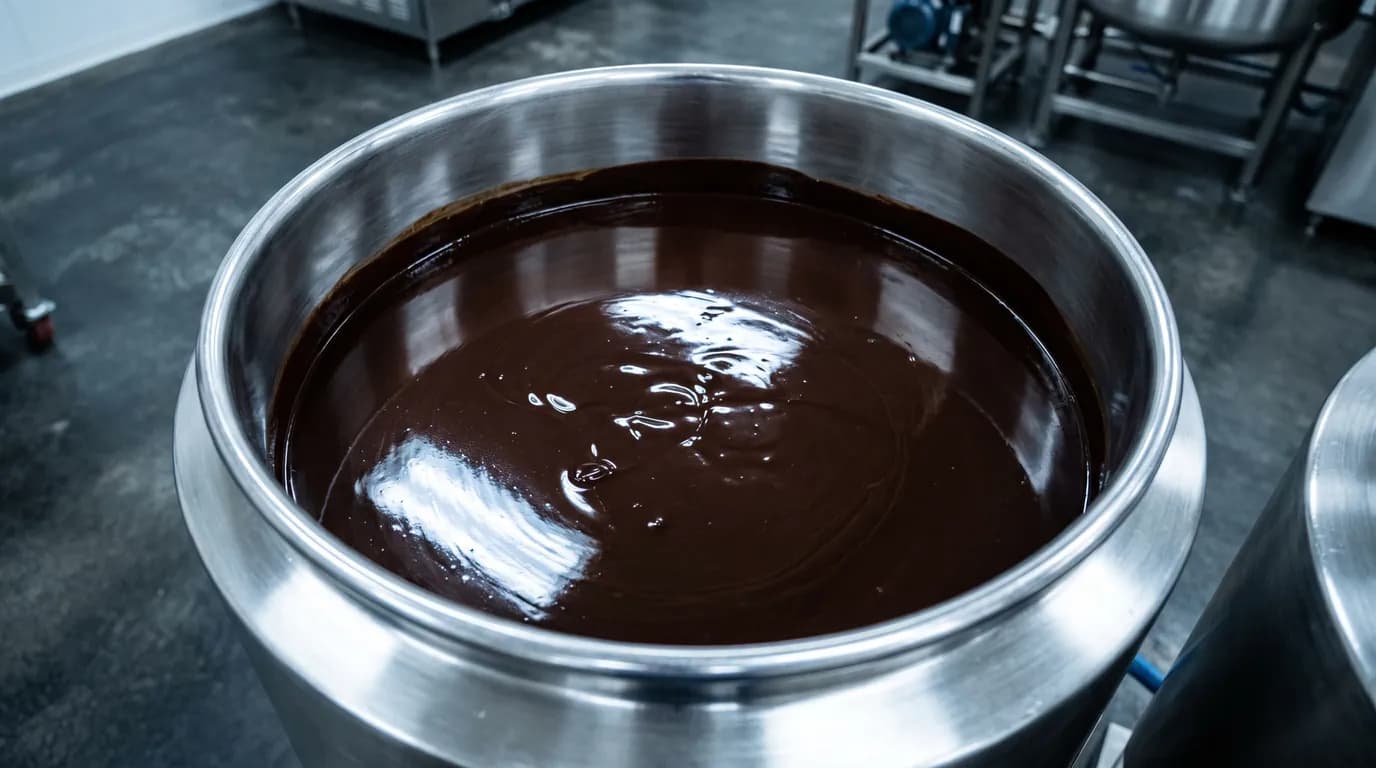
Table of Contents
- 01Confectionery Applications: The Base of Chocolate Refining
- 02Ice Cream, Dairy, and Bakery Applications
- 03Rheology: Casson Viscosity and Yield Stress
- 04Technical Specifications for Industrial Buyers
- 05Technical Specifications for Industrial Cocoa Liquor in Premium Chocolate Manufacturing
- 06Casson Plastic Viscosity and Yield Stress Parameters
- 07Bulk Storage: Managing Heated Holding Tanks
- 08Mechanical Degassing and Volatiles Extraction
- 09Fat Polymorphism and Crystallization Mechanics
- 10Particle Size Distribution via Laser Diffraction
- 11Liquid Bulk Shipment and Heated ISO-Tank Logistics
In the industrial food sector, cocoa liquor (also known as cocoa mass) is a fundamental building block. It is the primary ingredient that delivers flavor, color, and mouthfeel to chocolates, coatings, bakery fillings, and dairy products. For B2B procurement managers and food scientists, selecting the right source of cocoa liquor determines not only flavor consistency but also processing efficiency. In this guide, we analyze the industrial applications, rheological parameters, and bulk supply logistics of our single-origin Nacional Arriba cocoa liquor from Manabí, Ecuador, designed for food industry specialists.
Confectionery Applications: The Base of Chocolate Refining
Confectionery manufacturing relies heavily on the physical behavior of cocoa liquor. When mixed with sugar, extra cocoa butter, and milk solids, cocoa liquor forms the structural base of chocolate. The quality of the liquor impacts the refining process: a finely ground liquor with low moisture reduces the refining time needed in roll refiners and conches. Sourcing cocoa liquor from El Dulce Origen provides a high-quality ingredient for B2B manufacturers. Because we process our Nacional Arriba beans in our integrated facility in Cayambe, Pichincha, we control the initial milling, keeping moisture content below 1.5%. This prevents the viscosity spikes that can slow down refining lines and increase chocolate processing costs. Sourcing directly from our 100 allied farms guarantees a reliable, pure raw material that enhances production performance.
Read our Licor de cacao B2B guide for localized Spanish details. You can also review our comparison guide on liquor and ceremonial paste to determine the best material for your formulations. Sourcing directly from our 100 allied farms guarantees a reliable, pure raw material that enhances production performance. By controlling the post-harvest fermentation parameters, we deliver a cocoa mass that displays low acidity and optimal flavor consistency, reducing the conching time needed in chocolate factories.
Ice Cream, Dairy, and Bakery Applications
Beyond traditional chocolate bar production, cocoa liquor is widely used in other sectors of the food industry:
- Ice Cream and Dairy: Used to flavor chocolate ice creams, puddings, and chocolate milks. High-fat cocoa liquor (52-54% cocoa butter) provides a rich, creamy texture and mouthfeel that cocoa powder cannot duplicate.
- Compound Coatings: Formulated with vegetable fats for coating ice cream bars, biscuits, and confectionery. The liquor delivers the necessary color and intense chocolate flavor notes to cut through the sweet fat matrix.
- Bakery Fillings: Integrated into heat-stable chocolate fillings for croissants, cookies, and pastries. The natural fats in the liquor help maintain the structure of the filling during high-temperature oven baking.
For dairy processors, the particle size of the liquor is a critical parameter. A fine grind ensures that the cocoa particles remain suspended in chocolate milk, preventing sedimentation at the bottom of bottles and reducing the need for carrageenan stabilizers. This mechanical stability translates directly to a longer shelf-life for RTD products. In baking applications, the solid fat index of our cocoa mass provides structural strength to cookie doughs during high-heat baking.
Rheology: Casson Viscosity and Yield Stress
For chocolate engineers, the flow properties of cocoa liquor are modeled using the Casson fluid equation. The two key parameters are Casson plastic viscosity and Casson yield stress. A high yield stress requires more pumping pressure to start flow, which can cause blockages in automated lines. By controlling the moisture content and particle size distribution at our Cayambe plant, we supply cocoa liquor with consistent rheological parameters, minimizing processing friction and improving chocolate tempering yields. Our quality lab checks these values using rotational rheometers, providing complete physical specs for B2B chocolate factories. Managing the particle size distribution also prevents wear on industrial pumps and refiners.
Technical Specifications for Industrial Buyers
Procurement teams must ensure that every shipment of cocoa liquor meets precise chemical and rheological specifications. Our Cayambe plant exports under strict B2B quality controls: Fat Content: 52% - 54% (natural cocoa butter) by Soxhlet Extraction, Moisture Content: 1.5% maximum by Karl Fischer Titration, Fineness (Milling): 99.5% passing through 200 mesh by Wet Sieve Analysis, Shell (Husk) Content: 0.5% maximum by Microscopical Analysis.
These values ensure that the liquor behaves predictably in automated chocolate manufacturing lines. Sourcing from our integrated plant ensures a reliable, direct B2B supply, protecting your production efficiency. The low moisture level protects the crystallization process during tempering, ensuring your finished chocolates have a glossy appearance, clean snap, and stable shelf-life. Quality is backed by the continuous GMP monitoring of our plant; certificates of analysis (CoA) for heavy metals and microbiological safety can be commissioned on request for your contract volumes.
Looking to secure a direct, high-volume contract for premium Nacional Arriba cocoa liquor? Our sales and logistics teams in Ecuador can assist you with contract details and custom specifications. Contact us today to request technical sheets and sample shipments. Visit our Quote Page to outline your sourcing needs and connect with our team.
Technical Specifications for Industrial Cocoa Liquor in Premium Chocolate Manufacturing
For premium chocolate manufacturing the technical specifications for industrial cocoa liquor reduce to a short list of parameters that a buyer should see on the specification sheet and confirm on the certificate of analysis of each lot. The values below are the ones our plant works to for natural (non-alkalized) Nacional Arriba liquor.
| Parameter | Specification | Method |
|---|---|---|
| Fat content (natural cocoa butter) | 52% to 54% | Soxhlet extraction |
| Moisture | 1.5% maximum | Karl Fischer titration |
| Fineness | 99.5% passing 200 mesh | Wet sieve analysis |
| Shell (husk) content | 0.5% maximum | Microscopical analysis |
| Alkalization | None; natural liquor | Process declaration |
| Variety and origin | Nacional Arriba fine aroma, Ecuador | Lot traceability record |
| Heavy metals and microbiology | Within the limit of the destination market | Certificate of analysis, commissioned per lot on request |
Fat and moisture govern how the liquor behaves in tempering and enrobing; fineness and shell content govern mouthfeel and the wear on refiners downstream. A specification that states these four with their test methods, plus the alkalization status and the origin, is what separates a premium cocoa liquor supply contract from a commodity purchase.
Casson Plastic Viscosity and Yield Stress Parameters
In industrial chocolate lines, the flow properties of melted cocoa liquor are modeled as a non-Newtonian Casson fluid. The Casson plastic viscosity describes the resistance of the fluid to flow under high shear rates, while the Casson yield stress is the minimum force required to initiate flow. Sourcing our cocoa liquor from Manabí ensures consistent reological values. We keep moisture below 1.5% and control particle size, keeping the plastic viscosity and yield stress stable. This consistency prevents pumping blockages and ensures uniform coating thickness in confectionery and baking factories.
Bulk Storage: Managing Heated Holding Tanks
For B2B chocolate factories and large-scale bakeries, managing bulk cocoa liquor requires heated storage systems. Liquid cocoa liquor must be held in stainless steel tanks equipped with water jackets or electrical heating elements to maintain a temperature between 45°C and 50°C. Continuous low-speed agitation is necessary to prevent the solids from separating and settling at the bottom of the tank. Our technical team works with your plant engineers to coordinate transport and pumping, ensuring a seamless raw material transfer into your bulk holding systems.
Mechanical Degassing and Volatiles Extraction
A critical stage in the refinement of industrial cocoa mass is the extraction of undesirable volatile compounds. During the grinding process in our Cayambe facility, the liquid cocoa liquor is subjected to thin-film vacuum degassing. This thermal-mechanical treatment reduces residual free acetic acid and other volatile acid complexes formed during post-harvest fermentation. By dropping the volatile load, we increase the pH value slightly toward a more neutral profile and stabilize the flavor base. This degassing ensures that chocolate manufacturers can reduce conching times by up to 20%, as the precursor volatile notes have already been mechanically removed, resulting in a cleaner flavor profile with minimal bitterness.
Fat Polymorphism and Crystallization Mechanics
The cocoa butter present in our Nacional Arriba liquor (52% to 54%) behaves as a polymorphic fat, capable of crystallizing into six distinct crystal forms (designated Form I through VI). For industrial applications like chocolate coatings and molding, achieving a stable Form V (Beta-3) crystal structure is critical. During the solidification process in your tempering machinery, Form V crystals provide the high gloss, contraction characteristics, and melting point (34°C) demanded by premium brands. Sourcing our single-origin liquor ensures a stable triglyceride composition, allowing your tempering lines to achieve clean nucleation and preventing the development of fat bloom during storage.
Particle Size Distribution via Laser Diffraction
While wet sieve analysis provides a general quality check, modern chocolate factories require a precise understanding of particle size distribution (PSD). In our laboratory in Cayambe, we analyze every batch of cocoa liquor using laser diffraction spectrometers. We measure the D90 (where 90% of the particles are below a certain micron threshold) and the D50. For confectionery applications, we maintain a D90 of less than 25 microns. This ultra-fine milling ensures that the final chocolate has a smooth, melt-in-the-mouth texture without any sandy or grittiness feel, allowing brands to formulate premium desserts without additional refining cycles.
Liquid Bulk Shipment and Heated ISO-Tank Logistics
To optimize production efficiency and reduce energy costs, El Dulce Origen provides hot liquid delivery options for large-scale manufacturers. Instead of shipping solid blocks that must be unpacked and melted at your plant, we can transport liquid cocoa liquor directly in heated ISO-tanks or thermal IBC containers. The temperature inside the containers is maintained at 50°C to 52°C throughout transit. Upon arrival, the liquid mass is pumped directly into your holding tanks. This hot-fill logistics process eliminates waste from packaging materials, reduces energy consumption, and simplifies your raw material handling protocols.
The term organic cacao paste appears in briefs from wellness and ceremonial brands describing the same material this article covers: cocoa liquor, that is, ground nib in solid or liquid form with nothing added. The organic element is documentary and has to be verified per lot; the paste element is simply a different commercial name for the mass. When a supplier prices paste noticeably above liquor of the same fat content and origin, the difference is packaging and positioning rather than product, which is worth checking before a category is treated as a premium line.
Requests for organic chocolate liquor are, in composition terms, requests for the same ground nib described here with a certificate attached to the chain of custody. Nothing about the processing changes; what changes is the documentation and the segregation requirement in the plant, since certified and conventional material cannot share equipment without a documented cleaning and changeover procedure. That segregation cost is usually the reason certified liquor prices above conventional of identical origin and fat content, which is worth knowing before treating the premium as a quality signal.
Related reading: Ganache and Fudge Formulation: A Production Guide.
Liquor is the base ingredient; for finished couverture and bulk dark chocolate made to your specification, see bulk chocolate and couverture wholesale.
Cacao Liquor
Interested in sourcing this product directly from our factory in Cayambe, Pichincha?
Frequently Asked Questions About This Topic
What packaging formats do you offer for industrial cocoa liquor?
We supply our cocoa liquor in solid blocks of 5 kg or 10 kg, packed in cartons with protective PE bags, and shipped on full pallets.
Is your industrial cocoa liquor non-alkalized?
Yes, we produce natural, non-alkalized cocoa liquor to preserve the distinct floral and fruit flavor profile of the Nacional Arriba bean.
How do you control viscosity in your cocoa liquor?
We maintain a low moisture content (under 1.5%) and manage the particle size distribution during milling to ensure optimal flow properties.
What is the shelf life of B2B cocoa liquor blocks?
If kept in a cool, dry place below 18°C, our cocoa liquor blocks have a shelf life of 24 months from the date of manufacture.
Can you provide kosher or organic certifications?
We do not currently hold USDA Organic, EU Organic, or Kosher certifications. Our plant operates under continuous GMP monitoring, and organic certification can be pursued for long-term bulk contracts that require it.
Related articles
Cocoa Liquor vs. Ceremonial Cacao Paste: B2B Differences & Sourcing
An essential B2B guide comparing industrial cocoa liquor (cocoa mass) and stone-ground ceremonial cacao paste. Understand processing and specifications.
Read ArticleNatural vs. Alkalized Cocoa Powder: B2B Technical and Sensory Guide
A technical comparison between natural and alkalized (Dutch-process) cocoa powder. Learn about pH levels, solubility, B2B food applications, and quality specs.
Read ArticleFino de Aroma Cacao Sensory Profile: Arriba Nacional vs. CCN-51
A detailed B2B sensory analysis of fine aroma cacao. Learn how to cup cacao beans, evaluate floral profiles, and understand the price premium over CCN-51.
Read Article