Ganache and Fudge Formulation: A Production Guide
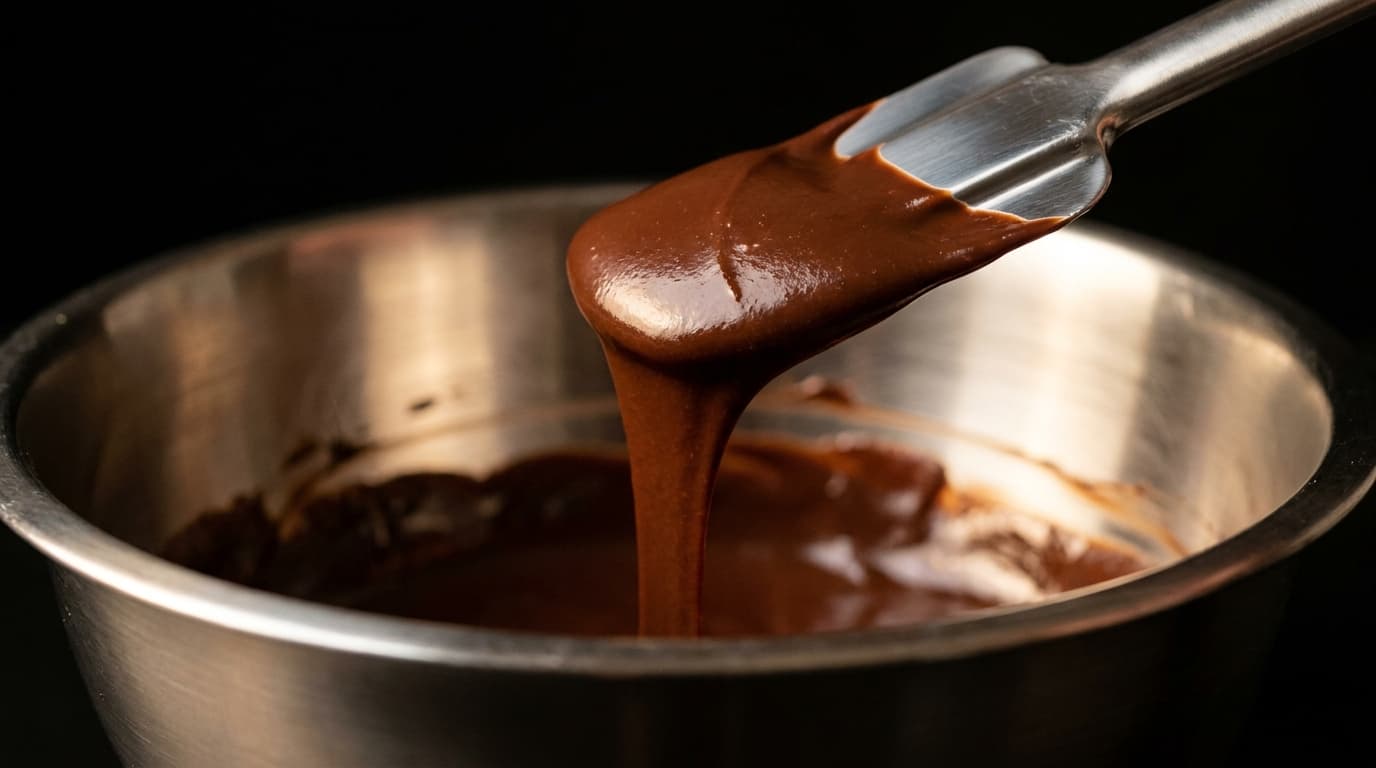
Table of Contents
- 01Ganache Is an Emulsion, Not a Mixture
- 02Ratios by Application
- 03Functional Sugars, Water Activity and Shelf Life
- 04Emulsion Temperature: Why Ganache Splits and How to Recover It
- 05Water and Juice Ganache Versus Cream
- 06Fudge Is Controlled Sugar Crystallisation
- 07Grainy Versus Creamy: The Variables You Control
- 08Choosing the Cocoa Component
- 09Production Quality Control
Ganache and fudge look like simple confections and behave like anything but. One is an emulsion that has to hold fat and water together against time and temperature; the other is a controlled sugar crystallisation where a few degrees decide between silk and sand. Both are where small producers lose money when they scale, because a recipe that works for twenty kilograms a week rarely survives a production run without being rewritten as a formulation.
This guide covers the physics behind both systems, the ratios that actually matter, shelf life through water activity, and the quality controls that keep a batch reproducible. It is written for obradores, industrial pastry operations and brands moving from artisan output to scheduled production.
Ganache Is an Emulsion, Not a Mixture
In a ganache, water from the cream is dispersed as droplets inside a continuous fat phase supplied by cocoa butter and milk fat. The cocoa solids and the milk proteins act as stabilisers at the interface. When the emulsion is correctly formed, the texture is glossy and the mouthfeel is short and clean; when it breaks, free fat separates and the surface turns grainy or oily.
Two variables dominate. The first is the ratio of water to fat: too much water and the emulsion inverts, too little and it becomes stiff and waxy. The second is shear and temperature during mixing: energy has to be enough to disperse the droplets, but heat above roughly 40 degrees Celsius destabilises the system and encourages separation. Understanding this is what separates a formulation from a recipe.
Ratios by Application
Ratios are expressed as chocolate to cream by weight, and they change with the application rather than with taste alone. A piped truffle centre typically runs between 2:1 and 2.5:1 with dark couverture, which gives enough structure to hold shape at room temperature. A soft moulded praline filling sits closer to 1.5:1 to 2:1. A glaze runs 1:1 or slightly cream-heavy so the coating flows and sets thin.
Milk and white chocolate change the arithmetic because they carry less cocoa solids and more sugar and milk fat. As a rule of thumb, milk chocolate needs roughly double the chocolate weight of a dark formulation for the same firmness, and white chocolate more still. Working directly with pure cocoa liquor instead of a finished couverture gives the formulator control over the sugar and lets the sweetness be set independently of the cocoa load.
Functional Sugars, Water Activity and Shelf Life
Shelf life in a ganache is governed by water activity rather than total moisture. Free water is what moulds and yeasts use; bound water is not available to them. Invert sugar, glucose syrup and sorbitol bind water and depress water activity, which is why they appear in almost every industrial ganache formulation.
A workshop ganache with no functional sugars typically lands around 0.88 to 0.92 water activity and needs refrigeration and a short sales window. Adding 8 to 12 percent invert sugar or sorbitol on the total mass can bring the value to 0.85 or below, which is where ambient shelf life of several weeks becomes realistic. Alcohol contributes in the same direction but changes flavour, and it is not a substitute for measurement: buy a water activity meter before you commit to an ambient-stable product claim.
Emulsion Temperature: Why Ganache Splits and How to Recover It
The classic failure is adding hot cream to cold chocolate and stirring aggressively. The fat melts unevenly, the emulsion never forms properly, and the mass looks curdled. The reliable sequence is to bring both phases to a compatible temperature, roughly 35 to 40 degrees for the chocolate and a similar range for the cream, then combine gradually while creating a stable core in the centre of the bowl before working outward.
A split ganache is usually recoverable. Adding a small amount of warm liquid, typically 5 to 10 percent of the mass, and blending with an immersion blender restores the droplet dispersion in most cases. The blender matters: hand stirring incorporates air and rarely rebuilds the interface. Once recovered, the ganache should be cooled slowly and left to set at controlled temperature, since rapid chilling promotes fat crystal defects that later show as surface dullness, the same mechanism described in our chocolate bloom guide.
Water and Juice Ganache Versus Cream
Water-based and juice-based ganaches have moved from novelty to standard practice for vegan lines and for intense fruit flavours. Replacing cream with water raises the proportion of free water and removes the milk proteins that helped stabilise the interface, so the formulation needs more emulsifying support: a higher cocoa solids fraction, added lecithin, or a small percentage of cocoa butter to rebalance the fat phase.
Juice adds acidity, and acidity destabilises emulsions. Below roughly pH 4 the risk of splitting rises sharply, so acidic purees are usually buffered or blended with a neutral base. The payoff is a cleaner, more direct fruit expression and a longer ambient shelf life than a dairy ganache at the same water activity, because there is no dairy substrate to support spoilage organisms.
Fudge Is Controlled Sugar Crystallisation
Fudge is a different physical system. Sugar, dairy and glucose are boiled to concentrate the syrup, then cooled and agitated to force the sucrose to crystallise in a controlled way. The goal is a dense population of very small crystals, below about 20 micrometres, which the tongue reads as creamy. Large crystals read as sandy.
The final boiling temperature sets the water content and therefore the firmness, typically 112 to 116 degrees Celsius for a standard fudge at sea level. Agitation timing is equally decisive: stirring while the syrup is still hot produces coarse crystals, while cooling undisturbed to around 45 degrees and only then agitating produces the fine structure. Glucose syrup and invert sugar act as crystallisation inhibitors, giving the operator a wider processing window.
Grainy Versus Creamy: The Variables You Control
Three levers decide the texture. Seeding, which means introducing fine crystals or previous batch material to direct nucleation; agitation temperature, which determines crystal size; and the ratio of inhibitor sugars to sucrose, which controls how easily crystals grow. A common industrial fault is scaling a workshop recipe into a larger kettle without adjusting cooling rate, because a bigger mass cools more slowly and crosses the critical zone at a different speed.
Fat matters too. Milk fat coats crystals and interrupts growth, which is why butter-rich fudge tolerates rougher handling. In a chocolate fudge, the cocoa butter contributes to the same effect, so a formulation shifted toward higher cocoa content usually needs a slightly different agitation point than the dairy-only version it replaced.
Choosing the Cocoa Component
Couverture is convenient because sugar, cocoa butter and lecithin are already balanced. Pure cocoa liquor is the better choice when the formulator wants to set sweetness independently, raise the cocoa fraction without adding sugar, or build a product with a specific origin character. Liquor also brings more non-fat cocoa solids, which absorb water and increase viscosity, so a straight substitution will produce a firmer ganache than expected.
As a starting point, replacing couverture with liquor requires adding sugar to match the original sweetness and adjusting cream upward by around 10 percent to compensate for the higher solids load. The technical detail of the raw material is covered in our overview of industrial uses of cocoa liquor.
Production Quality Control
Three records make both systems reproducible: temperature logs at each critical step, water activity on the finished centre, and a texture check against a retained reference sample. For fudge, add the final boiling temperature and the agitation start temperature; for ganache, add the emulsion temperature and the setting profile.
Retained samples are underused. Keeping one unit per batch under the same storage conditions as the sold product turns a customer complaint into a diagnosable event rather than an argument. If you are also specifying equipment for this stage, our guide to chocolate manufacturing equipment covers the tempering and depositing side.
To request technical data sheets, certificates of analysis or samples of cocoa liquor and couverture for your ganache and fudge formulations, use our contact page.
If you would rather buy the chocolate than make it, our page on bulk chocolate and couverture wholesale explains what can be produced to your recipe in Ecuador and what we do not stock.
Cacao Liquor
Interested in sourcing this product directly from our factory in Cayambe, Pichincha?
Frequently Asked Questions About This Topic
How much cream per kilo of chocolate in a ganache?
It depends on the application, not on taste alone. A piped truffle centre with dark couverture usually runs 2:1 to 2.5:1 chocolate to cream, a soft moulded filling 1.5:1 to 2:1, and a glaze around 1:1. Milk chocolate needs roughly double the chocolate weight of a dark formulation for the same firmness.
Why does ganache split?
Because the emulsion never formed or was destabilised: hot cream onto cold chocolate, mixing above roughly 40 degrees Celsius, or too much water for the available fat. Adding 5 to 10 percent warm liquid and blending with an immersion blender recovers most split batches.
How long does a ganache last?
Shelf life is set by water activity. Without functional sugars a ganache sits around 0.88 to 0.92 and needs refrigeration; 8 to 12 percent invert sugar or sorbitol can bring it to 0.85 or below, where several weeks at ambient temperature become realistic.
What is the difference between fudge and ganache?
Ganache is a water-in-fat emulsion stabilised by cocoa solids and milk proteins. Fudge is a controlled sugar crystallisation: syrup is boiled to 112 to 116 degrees Celsius, cooled undisturbed and then agitated so sucrose crystallises in very small crystals.
Related articles
Chocolate Manufacturing Equipment: Roaster to Enrober Explained
A plain-language walkthrough of every machine in a chocolate production line — roaster, winnower, melanger, conche, tempering and moulding — and how they fit together.
Read ArticleFDA Food Facility Registration for Chocolate & Cacao Exporters
What FDA food facility registration actually requires, how it differs from FSMA compliance and FSSC 22000/GMP, and why it matters for chocolate exporters.
Read ArticleHow Much Does a Chocolate Manufacturing Plant Cost?
There is no single number — but there are five cost drivers every banker or investor will ask about. A realistic breakdown, without invented figures.
Read Article