EUDR Deforestation Compliance: A B2B Green Coffee Import Guide
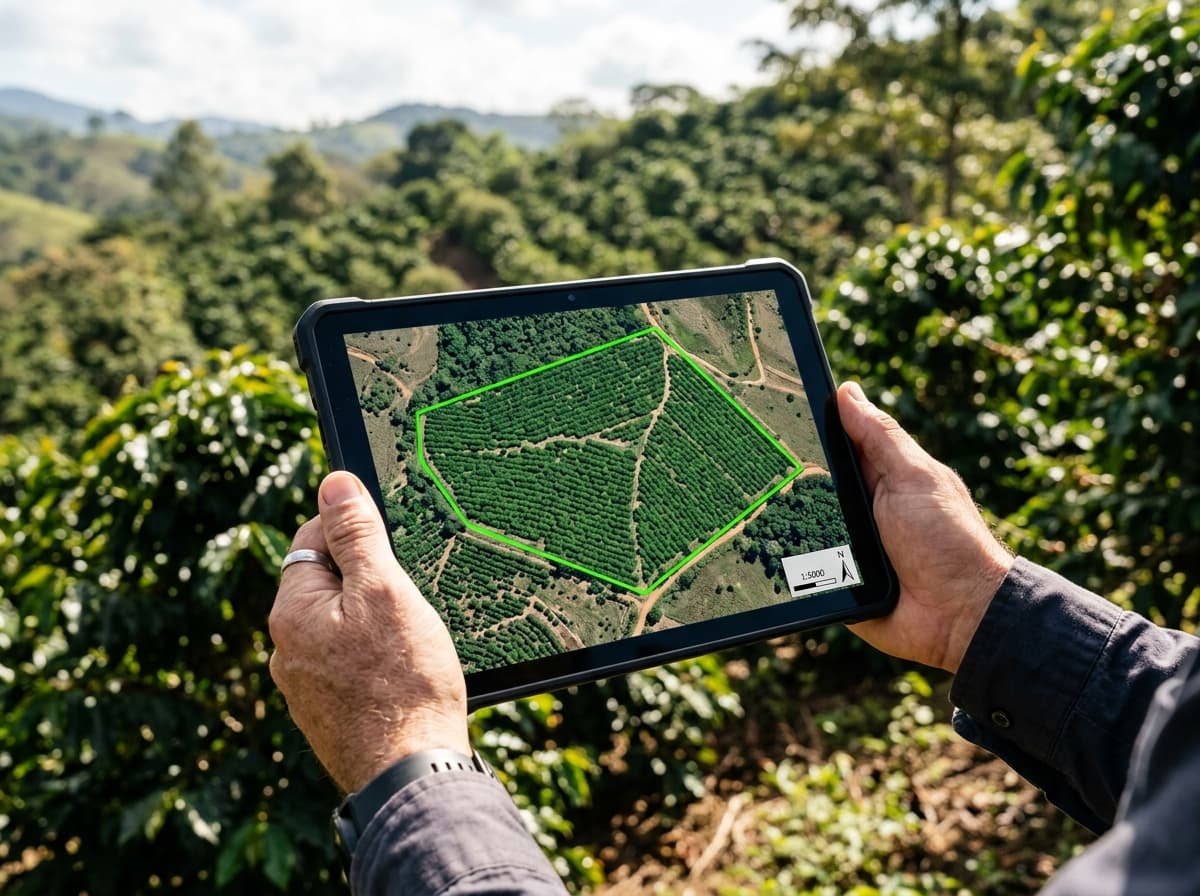
Table of Contents
- 01The Core Requirements of EUDR for Coffee
- 02Mitigating Supply Chain Disruptions
- 03What Actually Goes Into a Due Diligence Statement
- 04Enforcement Timeline and What Non-Compliance Costs
- 05Why Origin-Level Mapping Beats Reactive Compliance
- 06How EUDR Interacts With Other Coffee Certifications
- 07The Dates That Actually Apply After Regulation (EU) 2025/2650
- 08What Article 9 Actually Asks the Producing Side For
- 09The EUDR Covers Cocoa Too: What Changes for Cacao Importers
With the implementation of the European Union Deforestation Regulation (EUDR), the B2B green coffee importing landscape undergoes its most significant compliance shift in decades. Designed to prevent agricultural expansion into forested lands, this law demands that every shipment of coffee entering the European market prove it does not originate from deforested plots after December 31, 2020. This regulation has strict enforcement, making georeferenced compliance an absolute priority for roasters and buyers.
The Core Requirements of EUDR for Coffee
EUDR compliance requires green coffee importers to collect and submit a Due Diligence Statement (DDS) containing detailed geolocation data. For farms larger than 4 hectares, the regulation requires precise georeferenced polygon maps showing the boundary of the farm, while smaller plots require a single GPS coordinate point. This spatial data must be linked directly to the customs declaration, ensuring a digital trace from the specific plot of land in Ecuador to the port of entry in Europe (such as Rotterdam or Hamburg).
Mitigating Supply Chain Disruptions
Failure to supply valid georeferenced data results in immediate border rejection, confiscation of cargo, and severe financial penalties (up to 4% of the importer's annual EU turnover). For specialty coffee roasters, this compliance risk is managed by shifting away from anonymous regional trading platforms and toward vertically integrated direct trade exporters who maintain pre-mapped farm polygons. El Dulce Origen maps each associated farm, attaching the polygons to the customs documents at the Port of Guayaquil to prevent delays at destination. Learn more about our georeferenced specialty coffee sourcing practices.
What Actually Goes Into a Due Diligence Statement
The DDS is not a single form — it is a bundle of evidence the importer must be able to produce on request. Beyond the geolocation data itself, a complete DDS includes proof of legal land use (confirming the plot was not deforested or degraded after the cutoff date), a description of the product and its quantity, the country of production, and a risk assessment covering the specific supply chain the coffee moved through. Critically, the DDS must be submitted through the EU's Information System before the goods clear customs, and it must be linked to the specific shipment, not filed once as a blanket statement covering an entire relationship with a supplier. Every new harvest, every new container, requires its own submission tied to that shipment's actual geolocation data.
Enforcement Timeline and What Non-Compliance Costs
EUDR enforcement is staged by company size and shipment volume, and the compliance deadlines have already shifted twice, by Regulation (EU) 2024/3234 and Regulation (EU) 2025/2650, as the EU phased in the rule — buyers should treat the regulation as active now rather than wait for a final deadline. Under the risk-based inspection system, member state authorities are required to check a minimum percentage of operators and volumes from countries or regions flagged as standard or high risk, with non-compliant shipments subject to seizure at the border, forced market withdrawal if already distributed, and financial penalties that scale with the value of the non-compliant goods and the severity of the infringement — beyond the statutory maximum of 4% of EU annual turnover, repeat offenders can face exclusion from public procurement and EU funding. For a roaster or importer, the practical cost is rarely the fine itself; it is the container held at port, the missed delivery window to a retail customer, and the reputational cost of being flagged in the EU's public compliance database.
Why Origin-Level Mapping Beats Reactive Compliance
Importers who treat EUDR as a document to collect at the last minute, after a container is already booked, consistently run into the deadline pressure that causes shipment delays. The alternative is mapping supply relationships before they are needed commercially: georeferencing every associated farm as part of onboarding a new grower, maintaining that polygon data in a system that can be queried per shipment rather than re-collected each time, and building the DDS submission into the export paperwork workflow rather than treating it as a separate compliance project. This is the difference between EUDR being a routine customs step and EUDR being a recurring source of delayed containers.
How EUDR Interacts With Other Coffee Certifications
EUDR is a legal requirement, not a certification, and it does not replace the private schemes many buyers already require — Rainforest Alliance, Organic, or Fair Trade certification does not automatically satisfy EUDR's geolocation and due-diligence obligations, since those schemes were not built around this specific deforestation-cutoff and polygon-mapping standard. In practice, an origin that already runs a rigorous certification audit trail has a head start, because much of the farm-level data collection — plot boundaries, ownership records, harvest volumes — overlaps with what EUDR also requires. The gap that usually remains is the polygon-level geolocation itself, which most legacy certification schemes did not mandate at the same level of precision, so exporters holding an existing certification still need to close that specific mapping gap rather than assume it is already covered.
The Dates That Actually Apply After Regulation (EU) 2025/2650
The application calendar of the EUDR has been moved twice, and most sourcing documents in circulation still quote a date that has been superseded. As amended by Regulation (EU) 2025/2650, Articles 3 to 13, 16 to 24, 26, 31 and 32 of Regulation (EU) 2023/1115 apply from 30 December 2026. For natural persons and micro or small undertakings within the meaning of Directive 2013/34/EU that were established as such by 31 December 2024, those articles apply from 30 June 2027. The general review of the Regulation was moved to 30 June 2030, and Regulation (EU) No 995/2010, the old timber regulation, is repealed with effect from 30 December 2026.
Two consequences for a coffee supply chain. First, the extra time is not idle time: the cut-off date for deforestation-free status remains 31 December 2020, so a plot that was cleared in 2022 does not become compliant by waiting. Second, the obligation sits with the operator who places the product on the Union market — in practice the European importer — while the producing side supplies the geolocation of the plots, the evidence of legal production and the traceability that lets the operator file its due diligence statement. Exporters who assemble that dossier now are the ones who will still be quotable when the deadline arrives.
What Article 9 Actually Asks the Producing Side For
Behind the due diligence statement there is a documentary requirement that falls almost entirely on origin. Article 9 obliges the operator to collect, organise and keep for five years the information proving compliance: the country of production, the geolocation of all plots of land where the commodity was produced and the date or time range of production — and where a lot combines coffee from several plots, every plot has to be listed, not a representative sample of them. Annex II then requires the statement itself to carry the operator’s identification, including the EORI number, and the description of the product.
Read from the exporter’s desk, that turns a legal obligation into a data problem: plot polygons or coordinates tied to each delivery, a purchase record that survives the mixing of smallholder deliveries into one export lot, and a filing system that can still produce all of it five years later. Cooperatives that already register their members plot by plot are in a very different position from those that buy at the door without recording where the coffee came from.
The EUDR Covers Cocoa Too: What Changes for Cacao Importers
This guide is written for green coffee, but coffee is only one of the seven commodities in the EU Deforestation Regulation. Cocoa is another, and its scope is wider than many buyers expect. Annex I lists cocoa beans, whole or broken, raw or roasted (1801); cocoa shells, husks, skins and other cocoa waste (1802); cocoa paste or liquor (1803); cocoa butter, fat and oil (1804); cocoa powder without added sugar (1805); and chocolate and other food preparations containing cocoa (1806). Commission Delegated Regulation (EU) 2026/2102, in force since 18 September 2026, clarifies that cocoa waste within the meaning of the Waste Framework Directive is not covered under 1802.
The practical consequence is that an importer of cocoa liquor or cocoa butter is an operator in exactly the same way as an importer of beans. The geolocation in its due diligence statement has to reach back to the plots where the beans used for that liquor or butter were grown, so a processor at origin must keep lot-level traceability through roasting, grinding and pressing. The same dates apply as for coffee: 30 December 2026, and 30 June 2027 for operators that are natural persons or micro or small undertakings established as such by 31 December 2024. The cut-off date for deforestation-free production remains 31 December 2020.
For Ecuadorian cocoa and coffee alike, the country benchmark matters. Ecuador is on neither the low-risk nor the high-risk list of Commission Implementing Regulation (EU) 2025/1093, so it falls in the standard-risk category and imports from Ecuador follow standard due diligence. At El Dulce Origen, post-harvest processing of cacao is centralized in our own facility in Cayambe instead of being bought from collectors, which is what allows each lot to be traced back to the allied farms that supplied it.
German-speaking buyers can follow the current legal status of the regulation — both postponements, the Commission's May 2026 simplification report and the new product annex — in our regularly updated article EUDR: aktueller Stand der Entwaldungsverordnung (in German).
Specialty Green Coffee
Interested in sourcing this product directly from our factory in Cayambe, Pichincha?
Frequently Asked Questions About This Topic
Does the EUDR apply to cocoa as well as coffee?
Yes. Cocoa beans, shells, liquor, butter, powder and chocolate (headings 1801 to 1806) are in Annex I, with the same application dates as coffee: 30 December 2026, and 30 June 2027 for micro and small operators.
What is the EUDR cutoff date for deforestation?
Coffee must be grown on land that has not been subject to deforestation or forest degradation after December 31, 2020.
What geolocation data does EUDR require?
EUDR requires GPS points for plots under 4 hectares and georeferenced polygon boundary maps for plots larger than 4 hectares.
Does the Due Diligence Statement cover an entire relationship with a supplier?
No. A DDS is tied to a specific shipment and its actual geolocation data — a new harvest or new container requires its own submission through the EU's Information System, not a one-time blanket statement.
Related articles
Coffee Post-Harvest Processing: Washed, Natural, Honey & Anaerobic Chemistry
Explore the biochemistry of coffee post-harvest processing. Learn how washed, natural, honey, and anaerobic ferments shape green bean acidity and sweetness.
Read ArticleUnderstanding EU Cadmium Limits for Cacao: B2B Compliance & Import Guide
A complete guide to EU Regulation 488/2014 heavy metal limits for cacao imports. Learn how B2B buyers navigate compliance, testing, and soil mitigation.
Read ArticleHow Ecuadorian Cacao Growers Mitigate Cadmium Absorption: Soil Science & Process
Explore the agronomic techniques and soil management practices used in Manabí to naturally reduce cadmium uptake in fine aroma cacao trees.
Read Article