How to Prepare Cacao Beans: Roasting, Winnowing, and Stone-Milling
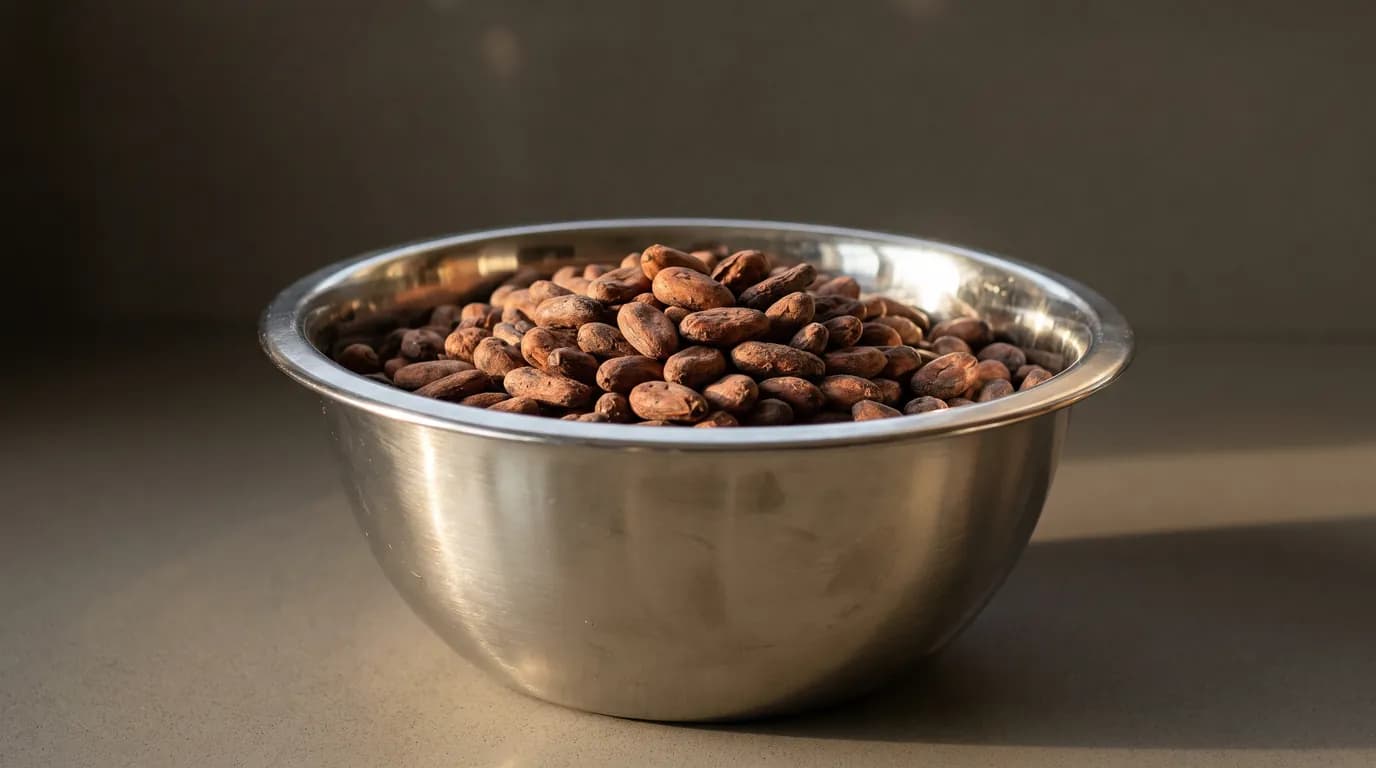
Table of Contents
- 01Step 1: Selecting and Sorting Cacao Beans
- 02Step 2: Roasting Cacao Beans - Temperature Profiles
- 03Step 3: Winnowing (Removing the Husk)
- 04Step 4: Grinding and Stone-Milling
- 05The Chemistry of Chocolate Tempering (Pre-Crystallization)
- 06Post-Processing Storage: Protecting Your Raw Materials
- 07Physical Grades and Custom Processing for B2B Contracts
- 08Quality Control Checkpoints During Roasting and Milling
- 09From Farm Network to Export-Ready Batches: Traceability
Processing raw cacao beans into edible formats is both a science and a traditional art form. Whether you are an artisanal chocolate maker, a wellness practitioner preparing ceremonial cacao, or a culinary expert experimenting with single-origin beans, understanding how to prepare and cook cacao seeds correctly is essential. In this B2B guide, we will break down the steps of roasting, winnowing, and stone-milling raw Nacional Arriba beans from El Dulce Origen, ensuring you preserve the active nutrients and complex aromas that define our Ecuadorian sourcing network across Manabí, Esmeraldas, and Pichincha. This technical walkthrough is designed for professionals who require consistent results in their kitchens or small-scale production lines.
Step 1: Selecting and Sorting Cacao Beans
Before initiating any thermal treatment, the beans must be sorted. While our beneficio plant in Cayambe, Pichincha, exports graded F1 beans (equivalent to ASSS, Arriba Super Fine Superior) that have already undergone automated sorting, manual inspection is still recommended. Remove any flat, broken, or residual dried pulp pieces. Starting with uniform beans ensures an even roast profile. Sourcing from our integrated network of roughly 100 partner farms across Manabí, Esmeraldas, and Pichincha ensures that the raw materials carry a distinctive sensory signature shaped by both coastal and Andean-foothill growing conditions. Sourcing authentic arriba cocoa beans and nacional cacao beans is the foundation of the craft chocolate movement, protecting biodiversity and supporting local farming families.
This terroir-driven quality is what differentiates specialty cacao from generic bulk commodities, allowing chocolatiers to create single-origin bars with unique flavor stories. If you want to learn how to grade cacao beans, check out our guide on ASE vs ASSS classifications. You can read more about this in our Ceremonial Cacao Wholesale Hub or explore our guide on post-harvest fermentation and drying chemistry. Sorting your raw materials directly from our integrated plant ensures complete traceability and consistent quality, helping you build a sustainable and successful product line.
Step 2: Roasting Cacao Beans - Temperature Profiles
Roasting is the critical phase where the precursors developed during fermentation transform into actual chocolate flavors. It also sanitizes the outer shell and makes it brittle for easy removal. The roasting process differs based on your goals:
- Artisanal Confectionery Roasting: Roast the beans at temperatures between 110°C and 130°C for 15 to 25 minutes. This profile reduces natural acidity and develops rich, nut-like notes. It is perfect for standard chocolate bars and baking ingredients.
- Ceremonial or Raw Roasting: To preserve the maximum level of antioxidants, magnesium, and active compounds, roast the beans at low temperatures (below 105°C) for 10 to 15 minutes, or dehydrate them. This keeps the cellular matrix intact, which is ideal for ceremonial applications.
Stir the beans constantly during roasting to avoid hot spots and scorching. You will know the beans are done when they emit a rich chocolate aroma, make a slight cracking sound, and the husks puff up and slide off easily when squeezed. Proper ventilation is required during this step to allow the volatile acetic acid to escape, preventing sour off-flavors in the finished product. In commercial ovens, the use of rotating drums is highly recommended to achieve a uniform thermal distribution across all bean sizes.
Step 3: Winnowing (Removing the Husk)
Winnowing (or descascarillado) is the process of separating the outer paper-like husk from the inner cotyledons (nibs). To winnow by hand:
- Let the roasted beans cool down until they are safe to handle.
- Gently crush the beans between your hands or using a rolling pin on a flat surface to break the husks without pulverizing the nibs.
- Use a fan or blow gently over the crushed mixture. The lightweight husks will blow away, leaving the dense, clean cacao nibs behind.
In B2B setups, we use automated winnowing machines that crush and extract the husks using calibrated air suction, keeping husk residue below 0.5% to protect the mill gears from wear. The clean nibs are then transferred directly to the grinding section, ensuring a hygienic workflow. Keeping the husk content low is also critical because the husk contains higher levels of heavy metals and has an abrasive texture that can ruin the mouthfeel of the finished chocolate.
Step 4: Grinding and Stone-Milling
To turn the dry, crunchy nibs into smooth chocolate or ceremonial paste, they must be ground. Cacao nibs contain approximately 52% to 54% natural fat (cocoa butter). As friction increases during grinding, the butter melts, transforming the solid nibs into a liquid paste called cocoa liquor or mass.
For high-quality results, use a granite stone-grinder (melanger). Add the clean nibs slowly, allowing the stones to crush them into a fluid paste. Grind for 12 to 24 hours to reduce the particle size below 20 microns, which is the threshold where the human tongue can no longer detect graininess. This is how authentic ceremonial paste is prepared, keeping all the natural fats without chemical refining or alkalization. The finished paste can be poured into molds, allowed to solidify, and stored for B2B wholesale distribution. In commercial kitchens, this stone-ground paste can be quickly melted to prepare ceremonial beverages, offering a smooth, frothy texture when whisked vigorously. Regular maintenance of the granite stones is crucial to ensure that no stone dust contaminates the paste and that the pressure is evenly distributed.
Are you looking to buy premium raw cacao beans or custom stone-ground ceremonial paste? Our beneficio plant in Cayambe, Pichincha, processes and exports single-origin Nacional Arriba sourced from partner farms across Manabí, Esmeraldas, and Pichincha directly to your facility. Contact our sales department to request technical sheets and bulk pricing contracts. Visit our Quote Page to discuss your sourcing needs with our Ecuadorian team.
The Chemistry of Chocolate Tempering (Pre-Crystallization)
Once you have ground your cacao beans into a smooth liquor using a granite melanger, the next step for chocolate making is tempering. Cocoa butter consists of polymorphic triglycerides that solidify into six distinct crystalline forms (I to VI) at different temperatures. To obtain a glossy finish, clean snap, and prevent fat bloom, you must pre-crystallize the chocolate to favor Form V (beta crystals). Melt the liquor to 45°C, cool it down to 27°C with constant agitation, and then gently reheat it to 31°C. This precise thermal treatment stabilizes the crystalline structure, ensuring a professional chocolate bar.
Post-Processing Storage: Protecting Your Raw Materials
After roasting and winnowing, the finished cocoa nibs or stones must be stored correctly to prevent degradation. Raw or roasted beans are highly hygroscopic, meaning they absorb moisture from the surrounding air. Store your materials in airtight containers, ideally with GrainPro liners, in a temperature-controlled environment between 16°C and 18°C. Relative humidity must be kept below 65% to prevent mold growth and rancidity of the natural fats. Proper storage preserves the volatile floral compounds of our Nacional Arriba beans, ensuring excellent flavor results in your final chocolate production.
Physical Grades and Custom Processing for B2B Contracts
Our raw materials are classified into two physical grades, F1 and F2 (equivalent to ASSS and ASE), based on bean size uniformity, defect count, and moisture consistency after drying. F1 lots are typically reserved for fine-flavor bean-to-bar production and ceremonial-grade paste, while F2 lots suit industrial roasting lines with tighter cost targets. Beyond Nacional Arriba, our flagship fine-flavor variety, we also process the fino de aroma sub-varieties balao and amelonado, each with subtly different acidity and floral notes once roasted, and CCN-51 beans are available on request for larger orders needing a higher yield and a more neutral flavor base. On contract processing orders, our technical team can help calibrate the roast curve toward a target cup profile you supply, whether that means a low-acid roast for milk chocolate inclusions or a lighter, floral roast for single-origin bars. Cocoa butter and cocoa powder derived from the same lot are co-manufactured and sold together in a fixed 30% butter to 70% powder ratio, available from a single container, which simplifies planning for buyers who need both press fractions from one origin batch.
Quality Control Checkpoints During Roasting and Milling
Consistency in a B2B contract depends on measurable checkpoints, not visual judgment alone. Before any bean enters the roaster, technicians run a cut test: a well-fermented Nacional Arriba bean shows a light brown to cinnamon interior, while a purple or slaty cut signals under-fermentation that would roast unevenly. Calibrated moisture meters confirm the beans sit near the target humidity before roasting and again after cooling, and each roast batch is documented with its full time-temperature curve so results stay repeatable across containers shipped months apart. During milling, particle size is periodically verified with a fineness gauge or laser diffraction before the paste is released for packing. Typical defects screened for include scorched husks from excessive roast heat, residual husk above the 0.5% tolerance that wears mill stones, and incomplete pre-crystallization during tempering, which shows up later as fat bloom. Our Cayambe facility operates under continuous BPM/GMP monitoring and carries FDA registration; organic, Kosher, or Halal certification is not held as a blanket claim but can be arranged under a specific supply contract, and heavy-metal testing via ICP-MS, benchmarked against the EU Regulation 488/2014 cadmium thresholds of 0.10 to 0.80 mg/kg depending on product category, is available on request at the buyer's cost.
From Farm Network to Export-Ready Batches: Traceability
The raw material behind every batch comes from a network of roughly 100 partner farms spread across Manabí, Esmeraldas, and Pichincha, at altitudes from sea level up to 800 meters, with many relationships built informally over close to six years on trust and repeat business rather than long-term formal contracts. Because the growing regions sit along the coast while our beneficio plant is located in Cayambe, in the Andean province of Pichincha, dried beans travel inland before roasting, winnowing, and milling take place under one roof. For export, finished nibs, liquor, or paste are packed in 60-kilogram jute sacks, optionally lined with hermetic GrainPro bags, and loaded into containers from the Port of Guayaquil worldwide. See our traceability program for the full chain from farm to container.
Ready to move from raw beans to a finished, processed cacao product for your production line? Contact our team to request samples and a technical data sheet.
Cacao Beans
Interested in sourcing this product directly from our factory in Cayambe, Pichincha?
Frequently Asked Questions About This Topic
Can you eat raw cacao beans without roasting?
Yes, but they will be very bitter and astringent, and they carry a higher microbiological risk since roasting kills any surface bacteria.
What is winnowing in cacao processing?
Winnowing is the mechanical or manual separation of the outer shell (husk) from the inner cacao cotyledons (nibs) after roasting.
How long do you need to grind nibs to get smooth chocolate?
Artisanal stone-milling typically takes 12 to 24 hours to reduce the particle size below 20 microns for a smooth mouthfeel.
Why is temperature control important during roasting?
Because excessive heat burns the delicate cocoa butter and destroys the volatile floral compounds, leaving the cacao bitter and flat.
What is the shelf life of raw cacao beans?
If kept in a cool, dry place inside sealed bags (like GrainPro), raw beans can be stored for up to two years without losing quality.
Related articles
Cacao Nibs Nutrition: Bioactive Compounds and Health Benefits
An in-depth analysis of cacao nibs nutritional value. Discover the science behind antioxidants, flavanols, and why sugar-free organic nibs are healthy.
Read ArticleCacao Nibs in Industrial Food Manufacturing: B2B Applications
Discover the role of cacao nibs in large-scale food manufacturing. A guide to bakery, granola, snack bars, chocolate inclusions, and wholesale logistics.
Read ArticleCeremonial Cacao Dosage, Preparation, and Sensory Effects: A B2B Guide
An essential B2B guide for wellness facilitators. Learn correct ceremonial cacao dosages, preparation methods, and the science of theobromine.
Read Article