Brewing Cocoa and Cacao Husk Tea: A B2B Sourcing Guide
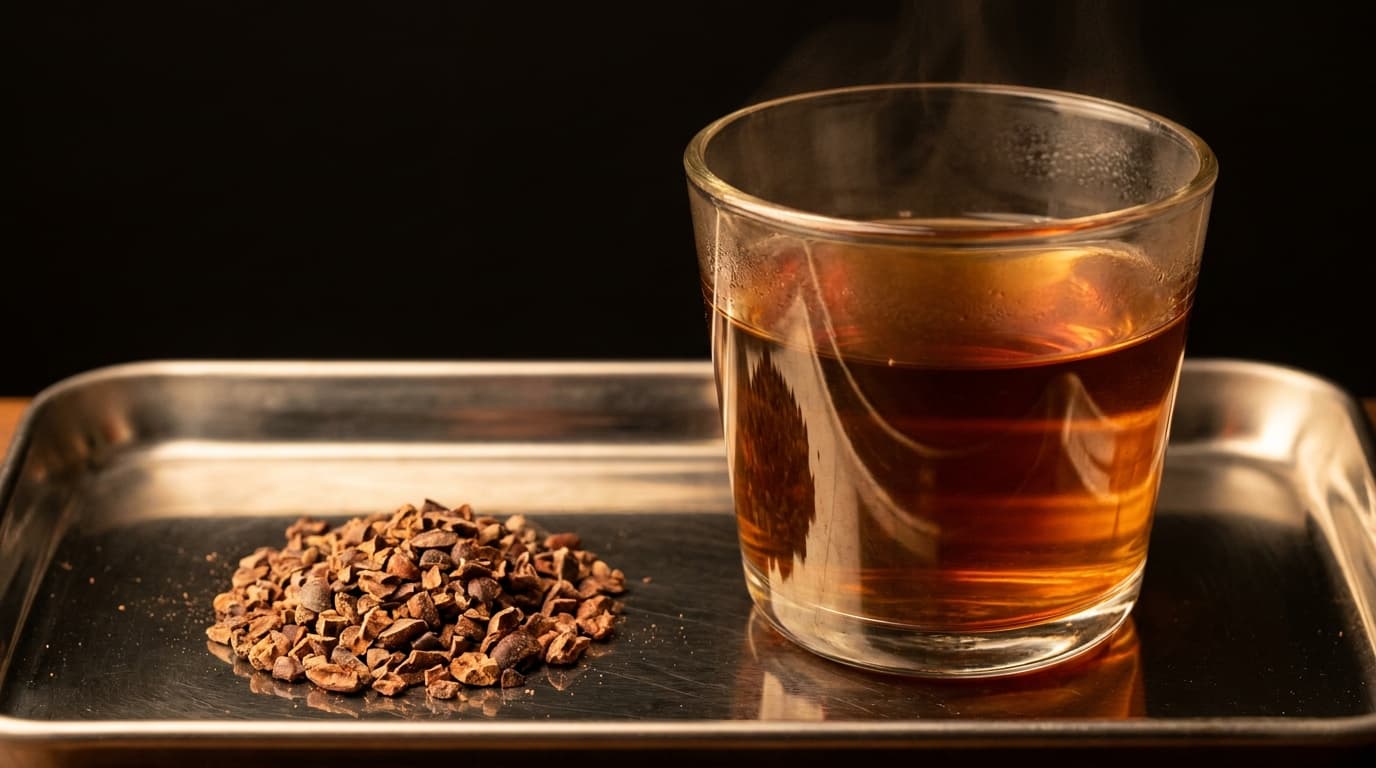
Table of Contents
- 01Brewing Cocoa and Cocoa Husk Tea Are Not the Same Product
- 02Cup Profile and Where Each Product Sits in the Market
- 03Particle Size and Grind Specification for Filtration
- 04Extraction Parameters for Service and for Bottled Product
- 05Caffeine and Theobromine in the Cup
- 06Food Safety: Roasting, Microbiology and Heavy Metals
- 07Why Husk Demands a Traceable Supplier
- 08From By-Product to Value Line: Formats and Economics
- 09What to Specify Before You Order
Every tonne of cacao beans that enters a grinding line leaves behind roughly 100 to 140 kilograms of shell. For most of the last century that shell went to animal feed, compost or the boiler. Over the past decade a different market has grown around it: cascara de cacao sold as a brewed beverage, alongside a related product made from coarsely broken nib. Beverage brands, tea houses and functional drink formulators now buy both, and they buy them to a technical specification rather than as a by-product.
This guide separates the two products, explains how each behaves in extraction, and sets out what a buyer should ask for before committing to a container. The distinction matters commercially: one is a premium fraction of the bean, the other is a shell fraction that only becomes food-grade when the supply chain is built for it.
Brewing Cocoa and Cocoa Husk Tea Are Not the Same Product
Brewing cocoa is made from roasted nib, cracked to a coarse particle and sometimes partially defatted. It is the same material a chocolate maker would grind into liquor, stopped several steps earlier. The cup carries real cocoa solids, a rounded body and the origin character of the bean.
Cocoa husk tea, sold as cascara or cocoa shell tea, uses the outer shell separated during winnowing. It brews lighter, with tea-like tannins, dried fruit notes and almost no fat. Because the shell sits on the outside of the bean throughout fermentation, drying and transport, its microbiological and heavy-metal history is completely different from that of the nib, which is why the two products need separate specifications and separate suppliers' guarantees.
If your product concept starts from the nib rather than the shell, our overview of what cacao nibs actually are covers the upstream processing in more detail.
Cup Profile and Where Each Product Sits in the Market
Brewing cocoa delivers a full-bodied infusion: cocoa, toasted nut, sometimes a dried-fruit acidity from a well-fermented Ecuadorian lot. Brands position it as a coffee alternative because the body is comparable while the stimulant profile is not. Serving temperature holds the aroma well, and the liquor stays visually clean if the fines are screened out.
Husk tea sits closer to a fruit infusion. Expect notes of raisin, tamarind and cocoa skin, with a light astringency that responds well to blending with hibiscus, citrus peel or spices. It is the cheaper input per kilogram and the more forgiving one in a tea bag format, but it also has a narrower flavour ceiling: a mediocre husk cannot be rescued by extraction technique.
Particle Size and Grind Specification for Filtration
Particle size drives both extraction rate and filtration behaviour. For brewing cocoa in a French press or batch brewer, a 2 to 4 millimetre particle works well; below one millimetre the fines pass through most filters and leave sediment in the cup. For tea bags and capsules the target is tighter, usually 0.5 to 2 millimetres with the dust screened off, because a bag that clogs extracts unevenly.
Ask the supplier for a sieve analysis, not a description. A specification that states the percentage retained on each mesh lets you reproduce the same cup across lots, and it is the single most useful document when you scale from pilot batches to a production run. Husk should also be checked for residual nib content: a shell fraction carrying loose nib will over-extract fat and cloud the beverage.
Extraction Parameters for Service and for Bottled Product
For hot service, 25 to 35 grams of brewing cocoa per litre at 95 degrees Celsius for six to ten minutes gives a balanced cup. Husk tea needs less material and less time: 12 to 18 grams per litre at 95 degrees for four to six minutes, since prolonged contact pushes the astringency forward.
Bottled and ready-to-drink formats change the calculation. Extraction is usually run stronger and then diluted, pasteurisation flattens some of the top aromatics, and any residual fat from the nib will separate on the shelf unless the product is homogenised or the fat is removed upstream. Cold extraction over twelve to sixteen hours produces a cleaner, sweeter profile with less astringency, which is why several bottled cascara products use it despite the longer cycle.
Caffeine and Theobromine in the Cup
Cacao contains both caffeine and theobromine, but in proportions unlike coffee. Theobromine dominates, and it acts more slowly and more mildly. A cup of brewing cocoa typically delivers a modest fraction of the caffeine in an equivalent cup of coffee, together with a substantially larger theobromine load. Husk tea extracts less of both, since most of the alkaloid content sits in the nib.
This is the functional argument brands use, and it is worth stating accurately rather than dramatically. We cover the underlying alkaloid chemistry in our article on caffeine and theobromine in cacao, which is the reference to use when writing label copy that must survive regulatory review.
Food Safety: Roasting, Microbiology and Heavy Metals
The shell is the outer surface of an agricultural product that has been fermented in wooden boxes and sun-dried on patios. Untreated, it carries a microbiological load that no beverage brand should accept. A validated roast step is the control point: time and temperature must be documented, and the finished product tested for total plate count, Enterobacteriaceae, Salmonella and moulds.
Heavy metals require the same discipline. Cadmium accumulates preferentially in certain growing zones, and the shell fraction can carry different concentrations than the nib from the same lot. Ask for lot-level analysis on the exact fraction you are buying rather than a generic bean certificate. Certificates of analysis are available on request for the material we ship, and the relevant limits for the destination market should be written into the contract, not assumed.
Why Husk Demands a Traceable Supplier
Shell is a low-value stream in a conventional supply chain, which means it is often aggregated across farms, warehouses and even across origins before anyone considers selling it as food. Once that happens, traceability is gone and so is any meaningful safety guarantee.
A food-grade husk programme has to be designed backwards from the beverage: sorted at the winnower, kept separate from floor sweepings, roasted as a dedicated batch, and documented with the same lot codes as the nib. That is only possible when the same operator controls fermentation, drying and winnowing. Buying cacao nibs and shell fractions from a single traceable origin is what makes the paperwork defensible.
From By-Product to Value Line: Formats and Economics
For a chocolate maker, husk sold as a beverage input converts a disposal cost into revenue, typically at several times the price of animal feed. For a beverage brand, it offers a story that is genuinely circular rather than decorative. Both arguments hold only if the volume is consistent, so contract the shell alongside the nib rather than opportunistically.
Commercial formats are straightforward: 10 or 25 kilogram multi-wall paper bags with a food-grade liner for husk, vacuum or nitrogen-flushed bags for brewing cocoa where fat oxidation is a concern. Shelf life is driven by moisture and fat: husk at controlled humidity holds well for a year or more, while brewing cocoa should be turned over faster because the residual cocoa butter will eventually stale.
What to Specify Before You Order
A workable purchase specification names the fraction (nib or shell), the origin and lot traceability level, the roast profile, the sieve analysis, moisture, fat content, microbiological limits, heavy metal limits and packaging. It should also fix the sample protocol: a pre-shipment sample from the actual lot, not a reference sample from a previous harvest.
Run the sample through your own brewing protocol before approving it, and record the extraction parameters you used. Suppliers can match a cup they can measure. To request technical specifications, certificates of analysis or a brewing sample from our Ecuadorian lots, use our contact page.
A large share of demand in this category comes from brands positioning the product as a cacao coffee alternative for consumers who want a warm ritual drink without coffee caffeine. The technical basis is real but modest: cacao contains only a small fraction of the caffeine found in coffee, and its dominant methylxanthine is theobromine, which is why the perceived effect is usually described as gentler and longer rather than sharper. For a beverage brand this matters twice over: the positioning has to stay factual, framed as a low-caffeine alternative rather than a caffeine-free one, and the sourcing has to be consistent, because a category built on ritual cannot tolerate a cup profile that changes between harvests.
A separate demand stream for the same by-product comes from horticulture, where cocoa bean hulls mulch and cocoa bean shells mulch are sold in garden retail for their appearance and slow breakdown. It is a legitimate outlet for shell volume that exceeds beverage demand, and it usually buys on different terms: coarser particle size, tolerance for fines, bulk bags rather than food-grade liners, and no microbiological specification. Two cautions apply before treating it as an easy secondary channel. Shell destined for mulch leaves the food chain, so it should be segregated and documented as such; and cocoa shell contains theobromine, which is toxic to dogs, so retail-bound volume normally carries a warning on the pack.
Buyers sometimes specify ground cacao for brewing instead of naming nib or husk, which leaves the most important variable undefined. Grind size determines extraction and filtration behaviour more than any other parameter here: a coarse grind under-extracts in a short brew and a fine one blinds the filter and pushes sediment into the cup. Give the sieve specification alongside the fraction, and validate it on your own equipment before approving the lot.
The positioning is often written as a chocolate coffee alternative or a chocolate coffee substitute, which describes the consumer benefit but understates the formulation problem: nothing in the cacao plant reproduces coffee's caffeine curve, so a product sold as a substitute has to win on ritual and mouthfeel rather than on stimulation. In practice the brands that hold repeat customers in this category are explicit about it, describing the drink as a different experience with a gentler lift, and they specify the raw material accordingly, husk for a lighter, tea-like cup and roasted brewing cocoa where a fuller body is wanted.
The horticultural outlet described above also appears in searches as cocoa beans for mulch, although what is actually sold is the shell rather than the bean. The same two conditions apply whichever phrasing the buyer uses: segregate the material as non-food once it is destined for garden use, and keep the theobromine warning on any pack going to consumers with pets.
Consumers describe the switch as drinking cocoa instead of coffee, and the retention data brands report back to us suggests the substitution works best when it is framed as an afternoon or evening option rather than a morning replacement. That is consistent with the pharmacology, since theobromine's slower onset does not reproduce the morning lift coffee provides. For product planning the implication is a smaller serving size and a fuller body than a coffee-replacement positioning would suggest.
Marketing teams sometimes go further and position the product as a cacao coffee replacement rather than an alternative, which is a claim worth tempering. Replacement implies functional equivalence, and the caffeine content does not support it; what cacao replaces is the ritual, the warmth and the afternoon habit, not the stimulant load. Brands that overstate this see it in returns and reviews, so the safer copy names the difference explicitly.
The shell fraction is also sold simply as cacao shells, and the naming is worth pinning down on the purchase order because shell, husk and hull are used interchangeably in the trade while referring to the same material: the outer layer removed during winnowing. What actually differs between offers is not the name but the specification, particularly the fines content and whether the material was separated from roasted or unroasted nib, since that determines the cup profile and the microbiological baseline.
Related demand appears as theobromine drinks, a positioning built on the methylxanthine profile rather than on flavour. It is a defensible angle provided the copy stays compositional, naming theobromine as the dominant methylxanthine and caffeine as present in small amounts, without extending into effect claims that fall outside the authorized wording.
Cacao Nibs
Interested in sourcing this product directly from our factory in Cayambe, Pichincha?
Frequently Asked Questions About This Topic
What is brewing cocoa?
Brewing cocoa is roasted cacao nib cracked to a coarse particle, usually 2 to 4 millimetres, and infused like coffee. It delivers real cocoa solids and a full body, and it is sometimes partially defatted so the beverage stays clean on the shelf.
Does cacao tea have caffeine?
Yes, but far less than coffee. The dominant alkaloid in cacao is theobromine, which acts more slowly and mildly. Husk tea extracts less of both alkaloids than brewing cocoa, since most of the alkaloid content sits in the nib rather than the shell.
What is the difference between brewing cocoa and cocoa husk tea?
Brewing cocoa is made from the nib, the inner part of the bean; husk tea uses the outer shell removed during winnowing. The nib gives body and cocoa flavour, the shell gives a lighter, tea-like infusion with dried fruit notes and almost no fat.
How do you brew it for commercial service?
For hot service use 25 to 35 grams of brewing cocoa per litre at 95 degrees Celsius for six to ten minutes, or 12 to 18 grams of husk per litre for four to six minutes. Bottled formats usually extract stronger and dilute, or use a twelve to sixteen hour cold extraction.
Related articles
Does Cacao Have Caffeine? The Truth About Stimulants in Cocoa Beans
A deep B2B analysis of the actual caffeine content in cacao vs. theobromine, featuring exact serving comparisons and stimulant profiles.
Read ArticleCriollo Cacao vs. Nacional Fine-Flavor: A Guide to Premium Varieties
Explore the genetic differences, flavor profiles, and commercial realities of Criollo and Ecuadorian Nacional fine-flavor cacao varieties.
Read ArticleTheobromine Benefits: The Active Energy Compound in Cacao Nibs
An objective industrial exploration of theobromine benefits, its physiological mechanisms, safety thresholds, and occurrence in cacao products.
Read Article